Transition and preparing for change
At Oak Farm Primary School, we recognise that change is a natural part of growing and learning but it can feel very different for every child.
For some children, moving into a new classroom is exciting. For others, meeting unfamiliar adults, adjusting to different routines or starting a new school can feel overwhelming.
We believe that successful transition is about much more than a single visit or a change of classroom. It is about helping children feel safe, prepared, understood and ready to take their next step.
Our approach combines thoughtful preparation, familiarisation, communication with families and careful information-sharing between staff. Where children need additional support, we adapt the process to suit their individual needs.
What Do We Mean by Transition?
Transition describes any period of change in a child's educational journey. This might include:
-
Starting Nursery or Reception for the first time.
-
Joining Oak Farm from another school.
-
Arriving in the UK and experiencing the English education system for the first time.
-
Moving into a new class or year group.
-
Getting to know new teachers, support staff, routines and environments.
-
Moving between mainstream classrooms and specialist or targeted provision.
-
Preparing to leave primary school and begin secondary education.
Transitions can also happen throughout the school day, such as moving between activities, lessons or environments.
We understand that every child's experience of change is different. Our aim is to make new experiences predictable, positive and accessible.
Joining the Oak Farm Family
Starting a new school is an important milestone for children and their families.
Whether your child is beginning their education in Nursery or Reception, joining us from another school or arriving from another country, we want them to feel welcomed and valued from the very beginning.
We take time to get to know each child, including their strengths, interests, previous experiences, communication preferences and any additional support they may need.
For children who are new to the UK, we recognise that adapting to a new country, language, culture and education system can involve significant change. We aim to support both children and families by explaining school routines clearly, using visual communication and providing opportunities to develop relationships and a sense of belonging.
Being new to English does not, in itself, mean a child has special educational needs. We carefully consider each child's individual circumstances and provide appropriate support.
Find Out More About Our Support for Children with English as an Additional Language
Moving Between Classes and Year Groups
Each year, we carefully plan the transition from one class to the next.
We recognise that even when children remain in the same school, a new classroom, teacher or routine can bring uncertainty.
Our whole-school transition arrangements include:
-
Staff handover meetings: Current and receiving teachers share important information about children's strengths, learning, friendships, wellbeing and support needs.
-
Transition Day: Children have an opportunity to spend time with their new class and begin getting to know their new teacher and classroom.
-
Meet the Teacher evenings: Families can meet staff, learn about the expectations and routines of the new year group and ask questions.
-
Visual transition booklets: Children can become familiar with their new classroom, adults, routines and expectations before the move takes place.
-
Additional transition support: Where appropriate, we arrange further familiarisation opportunities for children who may benefit from more preparation.
Our aim is to ensure that children do not feel they are starting again each September. Instead, we build upon what staff and families already know about them.
Our Class Transition Booklets
One of the ways we prepare children for change is through our Oak Farm Transition Booklets, which are created for every new class.
These accessible, symbol-supported booklets introduce children to the people, places and experiences they can expect in their new year group.
They include photographs and simple explanations of:
-
Their new classroom and class name.
-
Their teachers and familiar supporting adults.
-
Where they will play, learn and eat.
-
Important routines and expectations.
-
What might be different from their current year group.
-
What will stay familiar and where they can find help.
The booklets use photographs, simple language and visual symbols to make information easier to understand.
Families can look through them together at home, revisit particular pages and use them to start conversations about the new school year.
Familiarity helps reduce uncertainty. Knowing what a classroom looks like, recognising an adult's face or understanding where lunchtime will take place can make a meaningful difference to a child's confidence.
Explore Our 2026 Transition Booklets
Select your child's new class to view their transition booklet.
Nursery and Reception
Nursery · Rosewood · Jackalberry
Year 1
Year 2
Year 3
Year 4
Chestnut · Cypress · Jacarandas
Year 5
Year 6
Transition booklets are updated to reflect new classes, staffing and arrangements each academic year.
Additional Transition Support
We recognise that some children benefit from more time, repetition or individualised preparation.
Children who experience anxiety around change, have communication or sensory differences, require additional learning support or have previously found transitions challenging may be offered enhanced transition arrangements.
These might include:
-
Additional visits to their new classroom before the whole-school Transition Day.
-
Opportunities to meet new adults gradually in a quieter environment.
-
Personalised visual schedules, social stories or transition booklets.
-
Photographs of important people, places and routines.
-
Supported visits with a trusted adult.
-
Opportunities to practise unfamiliar routines and explore new environments.
-
Individual transition planning involving families, staff and relevant professionals.
Additional support is not limited to children with an identified SEND need or an EHCP. We consider each child's circumstances and what will help them feel secure and successful.
We also recognise that some children need support after a transition, not just beforehand. Staff continue to monitor wellbeing, engagement and adjustment once the change has taken place.
Explore Our Ordinarily Available Provision
Learn About Our Total Communication Approach
Preparing for Secondary School
The move from primary to secondary school is one of the biggest transitions in a child's educational journey.
It can involve a larger environment, different teachers, new friendships, unfamiliar routines and greater independence.
At Oak Farm, we aim to prepare children academically, socially and emotionally for this next chapter.
For children following the usual secondary admissions process, families apply through their local authority, and secondary schools coordinate their own induction and transition arrangements.
We strongly encourage families to visit secondary schools early, attend open evenings and explore the different environments and opportunities available. This can be particularly valuable for children who may need additional time to become familiar with a new setting.
For some pupils, we work with families and receiving schools to explore additional transition arrangements, including further visits, information-sharing and personalised preparation.
Secondary Transition for Children with an EHCP
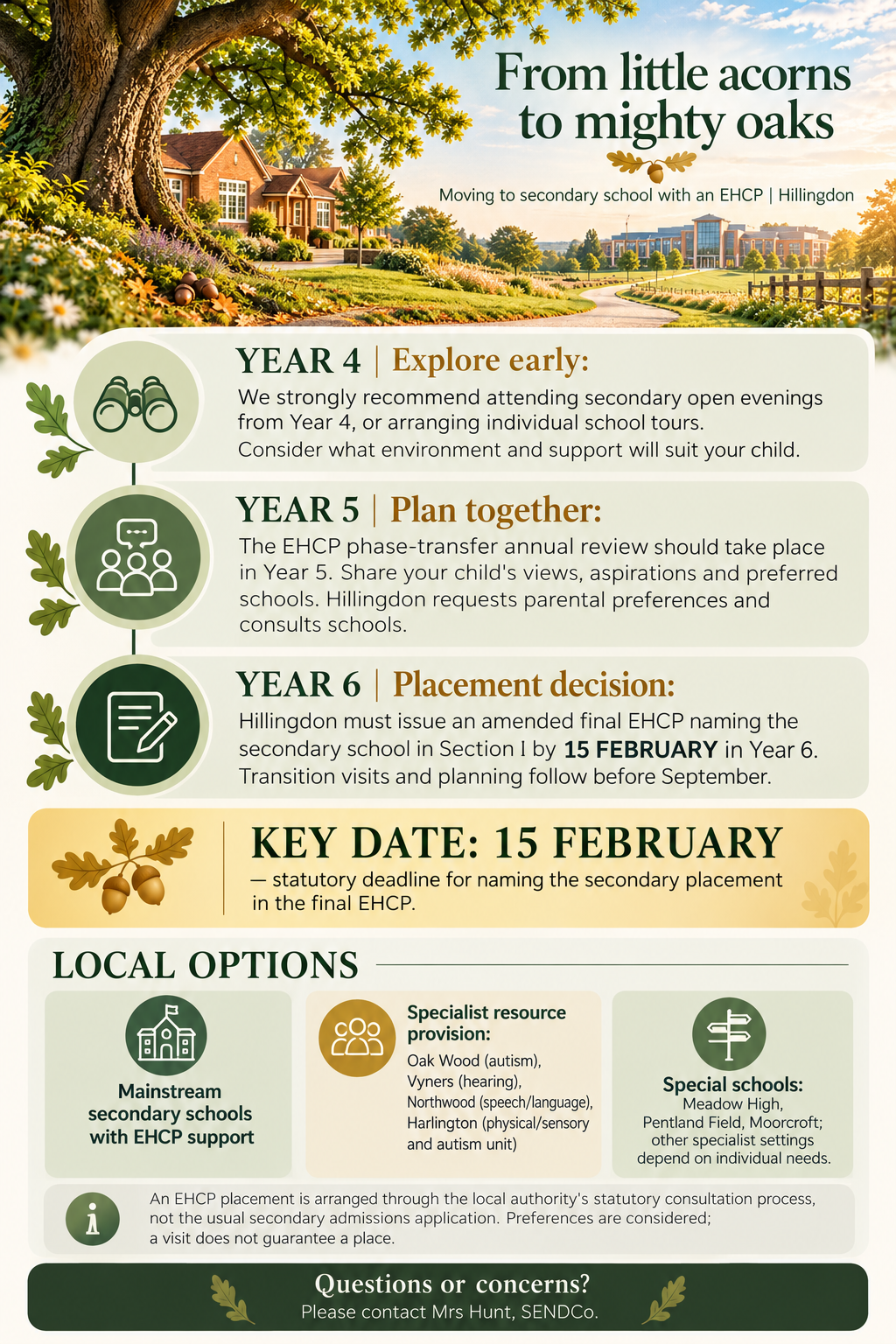
The secondary transfer process is different for children who have an Education, Health and Care Plan (EHCP).
Rather than relying solely on the usual secondary school admissions process, the move is managed through the statutory EHCP review and placement consultation process, coordinated by the local authority.
For a child moving to secondary school in September, the local authority must review and amend their EHCP, including naming the school or type of placement, by 15 February in the calendar year of transfer.
This process involves considering the child's needs, the provision required and the family's preferences. The local authority consults relevant schools before making its decision.
Families should begin exploring possible secondary schools well in advance. We particularly recommend attending open evenings and arranging visits from Year 4 onwards, where possible, so there is sufficient time to understand the available options.
At Oak Farm, we support families through this process by contributing to EHCP reviews, discussing needs and aspirations, sharing relevant information and working with the local authority and receiving school to plan a positive transition.
Having an EHCP does not automatically mean that a child will attend a specialist school. Placement decisions are based on the child's individual needs and the statutory consultation process.
Read more about Se condary School Transition
Working Together with Families
Parents and carers play a vital role in successful transitions.
You may notice concerns, questions or changes in your child's behaviour that are not immediately visible in school. Equally, your child may express excitement or worries about their next step in different ways.
We encourage families to share these experiences with us so that we can plan together.
At home, you can help by looking through transition booklets, talking positively but realistically about upcoming changes, visiting new places where possible and giving your child opportunities to ask questions or express their feelings.
It is also important to reassure children that they do not need to feel excited about every change. Feeling uncertain is normal, and confidence often develops gradually through familiarity and positive experiences.