Interventions & Targeted Support
At Oak Farm Primary School, we recognise that every child is unique and may benefit from additional support at different stages of their learning and development.
Our approach to interventions is needs-led, purposeful and inclusive. We identify barriers to learning, communication, wellbeing and independence, then carefully select support to help children develop the skills and confidence they need to thrive.
Receiving an intervention does not automatically mean that a child has Special Educational Needs or Disabilities (SEND).
Some children need short-term support to strengthen a particular skill, close a learning gap or build confidence. Others may benefit from more sustained, personalised or specialist provision.
Our aim is never to label children unnecessarily, but to understand their needs and provide the right support at the right time.
Different Levels of Support
Our starting point is always high-quality teaching and Ordinarily Available Provision (OAP). This includes adaptive teaching, visual supports, scaffolding, explicit vocabulary teaching and emotional regulation strategies that benefit all learners.
Where children need something additional, we provide:
-
Targeted interventions: Structured individual or small-group support to develop specific skills or address identified barriers.
-
Bespoke interventions: More personalised programmes adapted to a child's individual developmental, communication, learning or emotional needs.
-
Specialist-informed provision: Support guided by recommendations from professionals such as Speech and Language Therapists, Occupational Therapists and Educational Psychologists.
Interventions are selected following assessment and professional discussion. Not every programme is appropriate for every child, and availability may vary according to identified needs, staffing and the organisation of provision.
We carefully balance additional support with children's access to classroom teaching, friendships and the wider curriculum.
Our Interventions Across the Four Areas of Need
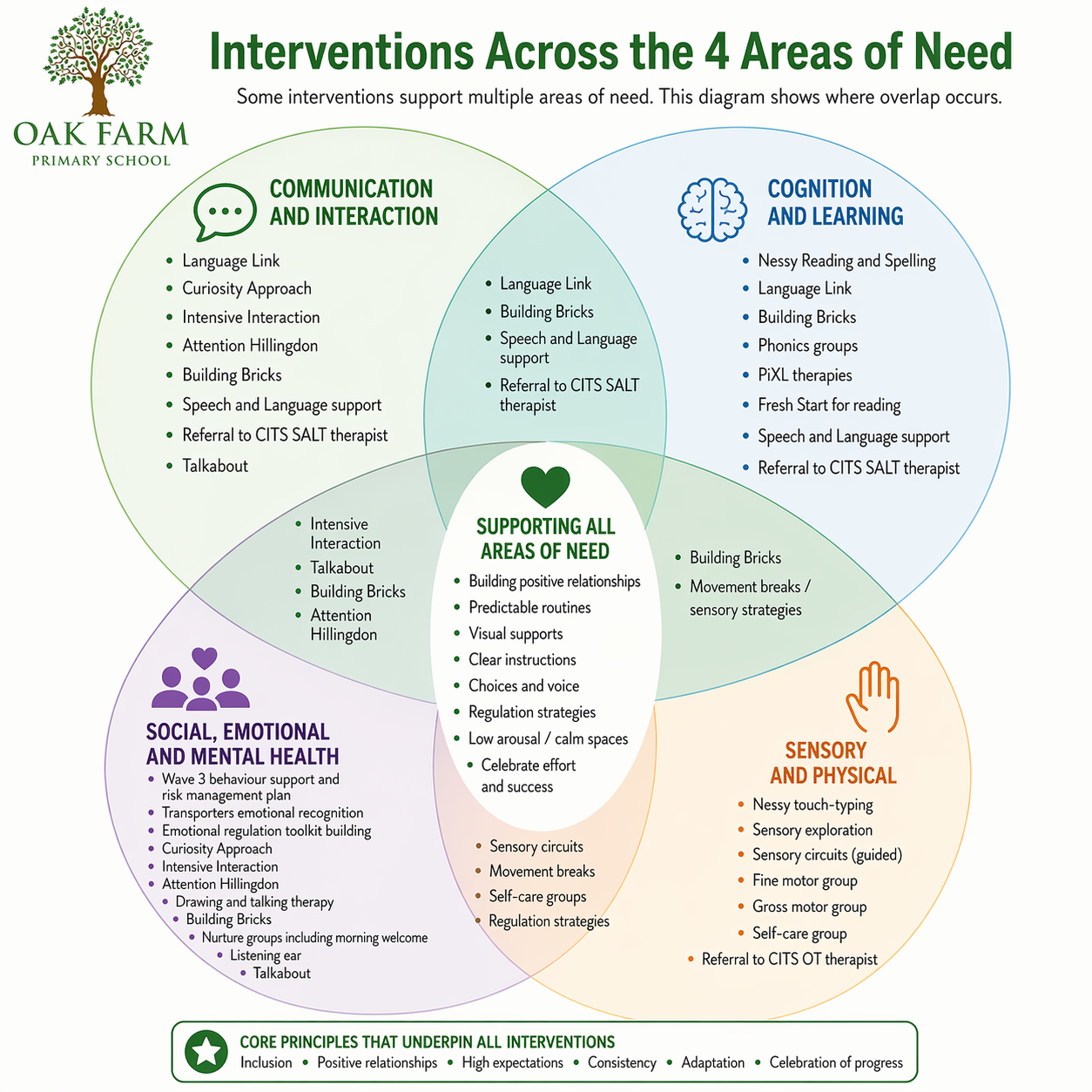
Our intervention offer supports children's development across the four broad areas of need identified in the SEND Code of Practice.
Communication and Interaction
Supporting attention, listening, understanding, speech, language and social communication.
Our approaches include Language Link, Attention Hillingdon, Building Bricks, Intensive Interaction, Talkabout and speech and language programmes informed by specialist advice.
Cognition and Learning
Developing foundational learning skills, addressing gaps in understanding and building confidence and independence.
Support may include targeted phonics, additional reading and numeracy programmes, Nessy, Fresh Start and personalised learning activities.
Social, Emotional and Mental Health
Supporting emotional awareness, self-regulation, confidence, relationships, resilience and a positive sense of belonging.
Our approaches include nurture groups, Drawing and Talking, emotional regulation toolkits, Talkabout, wellbeing activities and personalised pastoral support.
Sensory and Physical Development
Supporting coordination, sensory regulation, motor development, self-care and independence.
Provision may include Sensory Circuits, fine and gross motor groups, sensory exploration and occupational therapy-informed activities.
Children's needs do not fit neatly into separate categories. Many interventions support several areas of development simultaneously.
For example, Building Bricks can develop communication, turn-taking, problem-solving, cooperation and emotional regulation within the same activity.
Careful Provision Mapping – The Right Support for the Right Child
We do not introduce interventions simply because a child is finding something difficult. We consider why a barrier exists, what the child needs to develop and which approach is most likely to make a meaningful difference.
Our provision mapping process brings together teacher observations, assessment information, pupil and parent voice, and specialist advice where appropriate.
We consider the child's starting point, the intended outcome, the most appropriate provision and how progress will be measured.
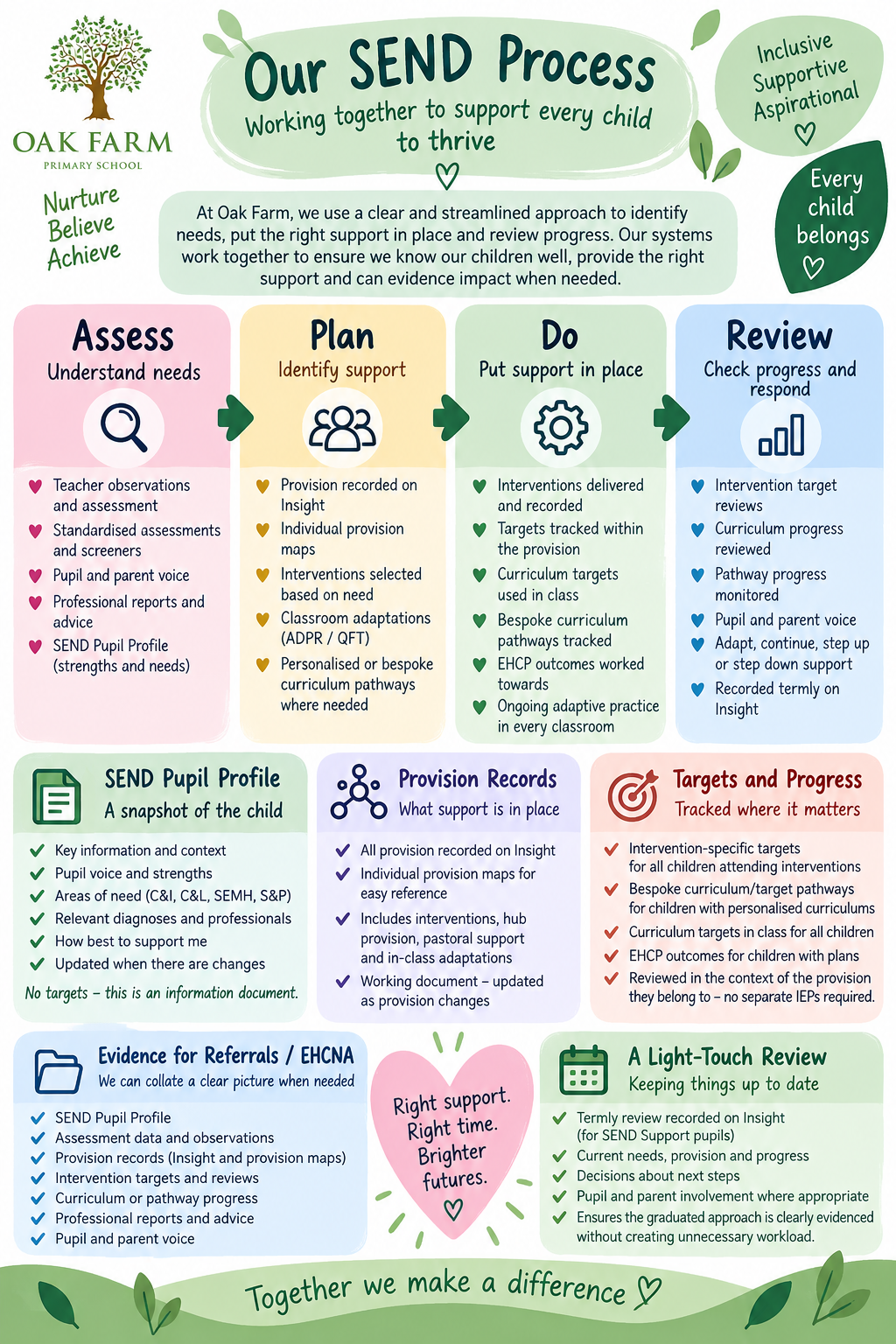
All targeted and bespoke provision is recorded and monitored through Insight, our school's assessment and provision tracking system. This helps us maintain a coordinated overview of support and ensure that interventions complement classroom teaching rather than operate in isolation.
Our approach is flexible: support may be introduced, adapted, increased or reduced as children's needs change.
Measuring Progress – Making Every Intervention Count
At Oak Farm, we believe that the success of an intervention is measured by its impact on the child, not simply the number of sessions delivered.
Where appropriate, we establish a starting point, identify clear targets and review progress using assessment information, observations and feedback from children, families and staff.
Progress may include improved reading skills, stronger communication, increased confidence, more positive relationships, greater emotional awareness or increased independence.
Importantly, we look beyond progress within an intervention session.
The most meaningful progress happens when children can apply their developing skills in everyday classroom learning and school life.
Reviews help us decide whether an intervention should continue, change, increase or come to an end. For children receiving SEN Support, this forms part of our ongoing Assess – Plan – Do – Review cycle.
Not every child attending an intervention requires a formal SEND plan. The level of documentation and review is proportionate to individual need, while ensuring that provision remains purposeful and its impact is understood.
Working with Specialist Professionals
Some children benefit from programmes developed or informed by external specialists.
We work collaboratively with Speech and Language Therapists, Occupational Therapists, Educational Psychologists, Hillingdon's SEND Advisory Service and other relevant professionals to strengthen our provision.
Where specialist recommendations are made, our priority is to ensure that useful strategies are embedded into children's everyday experiences, not confined to individual intervention sessions.
School-delivered interventions and referrals to external services are different forms of support. Specialist assessments and clinical therapies are subject to the relevant service's criteria and availability.
Working Together with Families
Parents and carers play an essential role in helping us understand children's strengths, experiences and needs.
We value family observations and children's own voices when identifying barriers, selecting support and reviewing progress.
Our ambition is to help children develop the skills, confidence and independence to participate fully in school life, with support that is responsive to their changing needs.
If you would like to discuss an intervention your child is receiving, please speak to their class teacher in the first instance.
Our SENDCo, Mrs Samantha Hunt, is also available to provide further advice and guidance.
Email: send@oakfarmprimary.org.uk
Telephone: 01895 590375
An intervention is not a label. It is an opportunity to remove a barrier, develop a skill and help a child flourish.