SEND and the graduated approach
Every Child. Every Opportunity. Every Day.
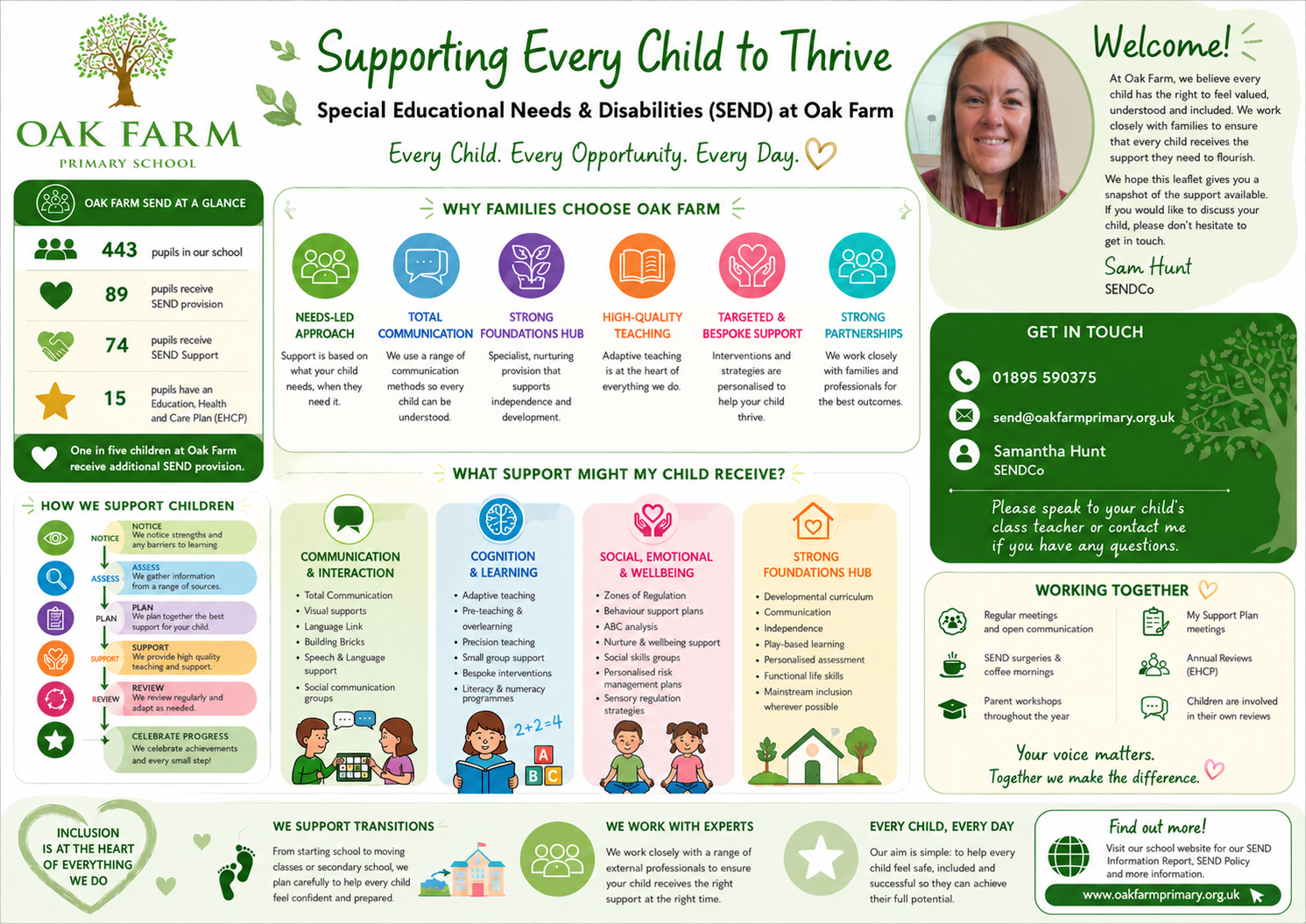
At Oak Farm Primary School, we believe that every child deserves to feel safe, valued, understood and included. Inclusion is at the heart of everything we do, and we are committed to ensuring that all children, regardless of their individual needs, have the opportunity to belong, thrive and achieve.
We recognise that every child is unique. Through high-quality teaching, early identification and personalised support where needed, we work to understand each child's strengths, recognise potential barriers and provide the right support at the right time.
SEND is not just the responsibility of one team – it is a shared commitment across our whole school community. Every adult plays a role in creating an inclusive environment where children feel that they belong.
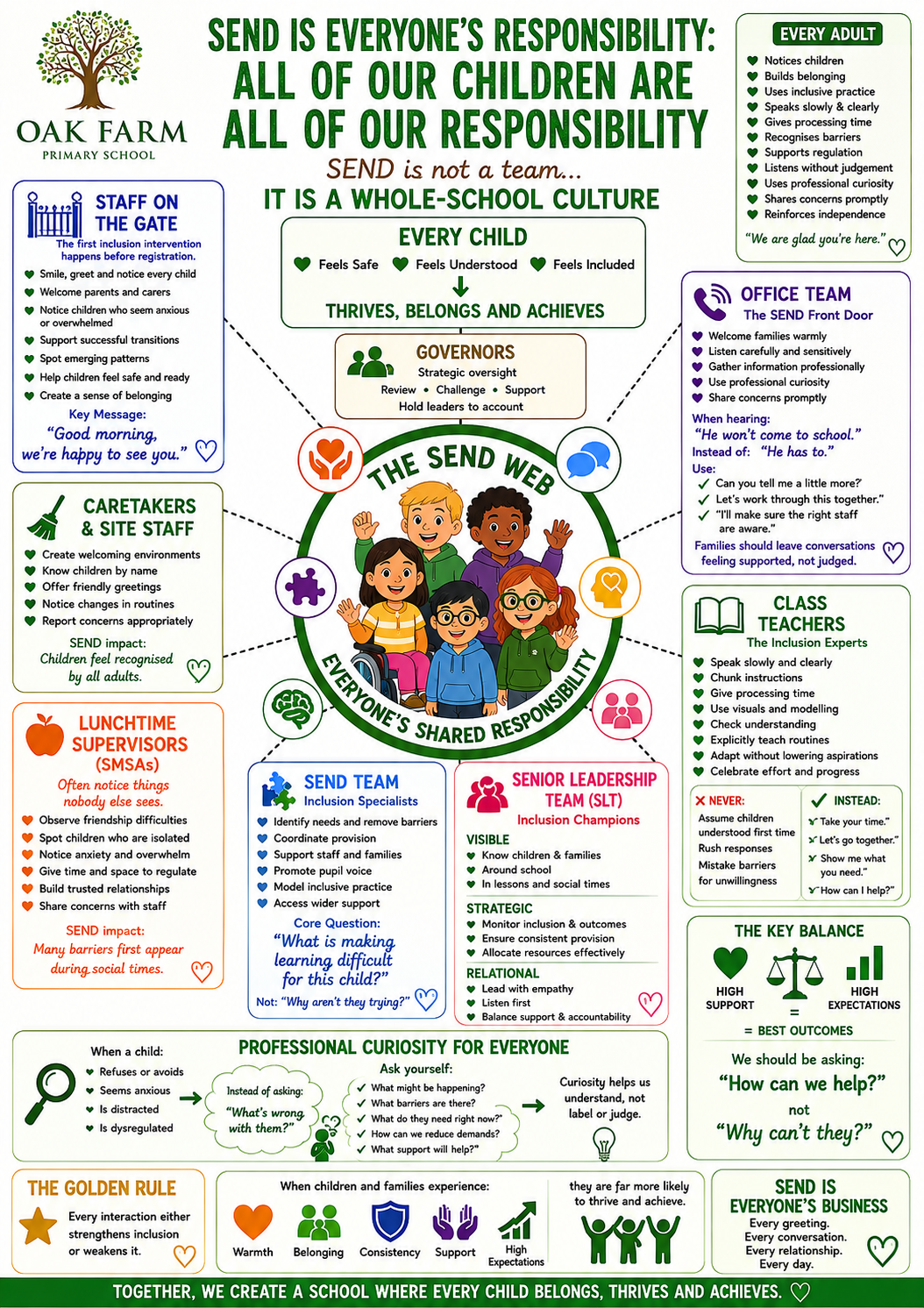
Our SEND information leaflet provides a helpful overview of our inclusive approach, the support available and how we work in partnership with families.
Early Identification – Understanding Every Child
We believe that the earlier we understand a child's needs, the sooner we can remove barriers and help them flourish.
Early identification is a key priority at Oak Farm. We do not wait for children to fall significantly behind, or for a formal diagnosis, before considering what support may be helpful.
Our teachers and SEND team use a range of observations, assessments and professional discussions to build a holistic picture of each child's development.
These include:
-
DfE SEND Assessment Tool: Helps us understand and monitor development across the four broad areas of SEND, identifying strengths, emerging needs and progress over time.
-
Little Link and Language Link: Support the early identification of speech, language and communication difficulties, including in Nursery and Reception.
-
Early Years baseline and developmental assessments: Help us understand children's starting points, developmental milestones and readiness for learning.
-
Classroom observations and curriculum assessments: Allow us to identify patterns in learning, engagement, communication, independence and emotional wellbeing.
-
Parent and pupil voice: Families know their children best, and children's own experiences are essential to understanding what helps them succeed.
We also draw on Hillingdon's Early Identification Toolkit, specialist screening tools and professional advice where appropriate.
Importantly, identifying an additional need does not automatically mean a child has SEND. Some children need a little extra time, adaptation or short-term support. Our role is to understand the reasons behind any difficulties and respond appropriately.
LA Early Identification toolkit
The Four Broad Areas of SEND
The SEND Code of Practice identifies four broad areas of need:
-
Communication and Interaction: Including speech, language, understanding, social communication and interaction.
-
Cognition and Learning: Including difficulties with acquiring, retaining or applying knowledge and skills.
-
Social, Emotional and Mental Health: Including emotional regulation, anxiety, attention, relationships and wellbeing.
-
Sensory and/or Physical Needs: Including sensory processing, hearing or visual impairments, physical development and mobility.
Children may experience needs across more than one area and their needs can change over time.
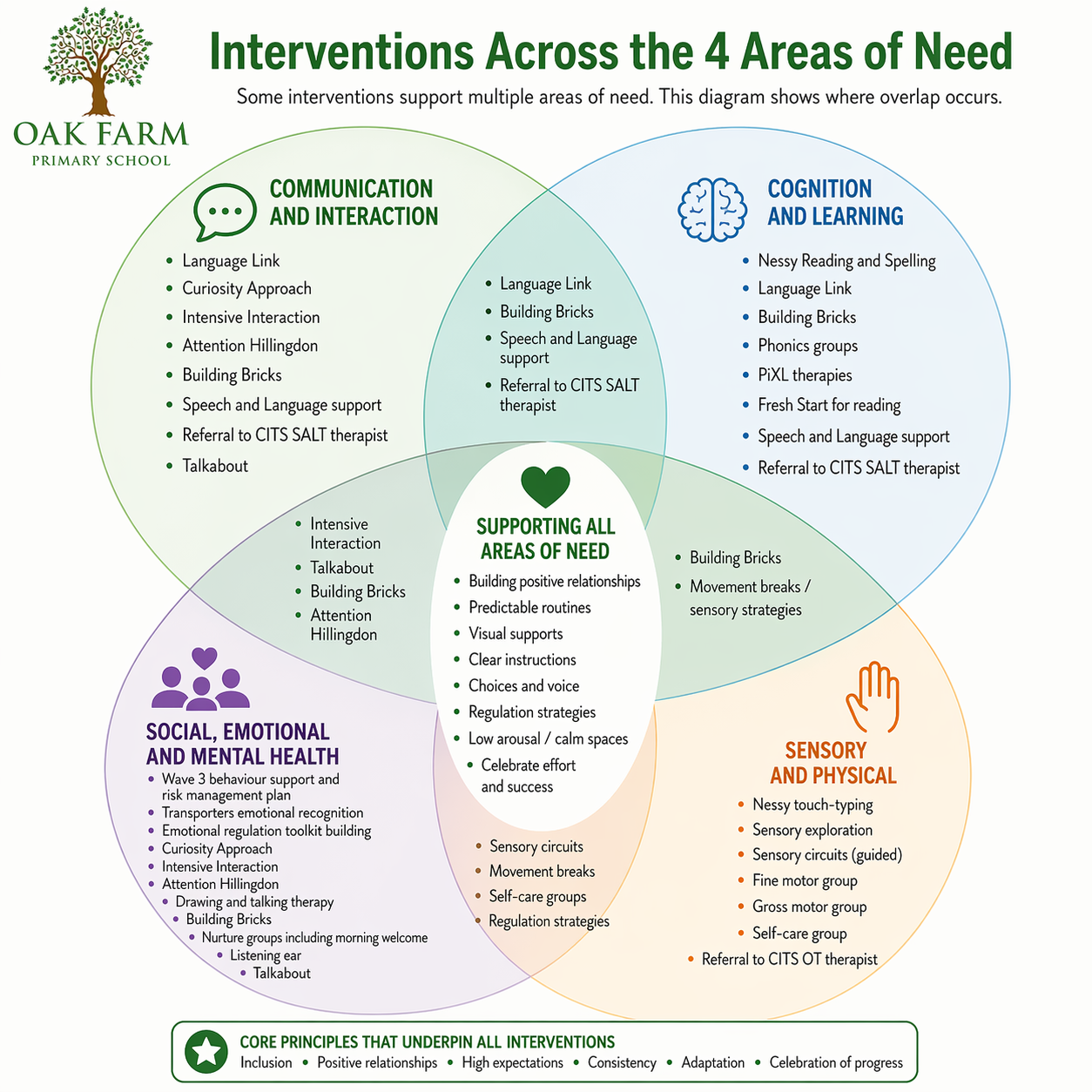
At Oak Farm, we offer a wide range of interventions and adaptations across these areas. Many approaches support more than one area of development, recognising that children's needs do not fit neatly into separate categories.
Oak Farm intervention across the 4 areas of need
Our Graduated Approach – Assess, Plan, Do, Review
At Oak Farm, we follow the Graduated Approach, as outlined in the SEND Code of Practice.
This is a continuous cycle of Assess – Plan – Do – Review (APDR), helping us understand children's needs, introduce appropriate support, evaluate its impact and make changes when necessary.
Assess – Understand the child
We gather information from teachers, assessments, observations, families, pupils and relevant professionals to identify strengths, needs and barriers to learning.
Plan – Agree the right support
We identify appropriate strategies, classroom adaptations, interventions or personalised provision. We consider what we want the child to achieve and how we will recognise progress.
Do – Put support into practice
Teachers and support staff implement agreed strategies through everyday teaching, targeted interventions or specialist provision. The class teacher remains responsible for the child's learning and progress.
Review – Evaluate and adapt
We consider what is working, what progress has been made and whether support needs to continue, change or increase. Families and children contribute to these discussions wherever appropriate.
Importantly, the Graduated Approach is not always a formal document or a lengthy process.
It may be a teacher noticing a difficulty, adapting an explanation, introducing a visual support and checking whether this helps. For other children, it involves more structured assessment, personalised provision and regular recorded reviews.
The principle remains the same: notice, understand, support, review and respond.
Our SEND Process – How We Assess, Plan, Do and Review
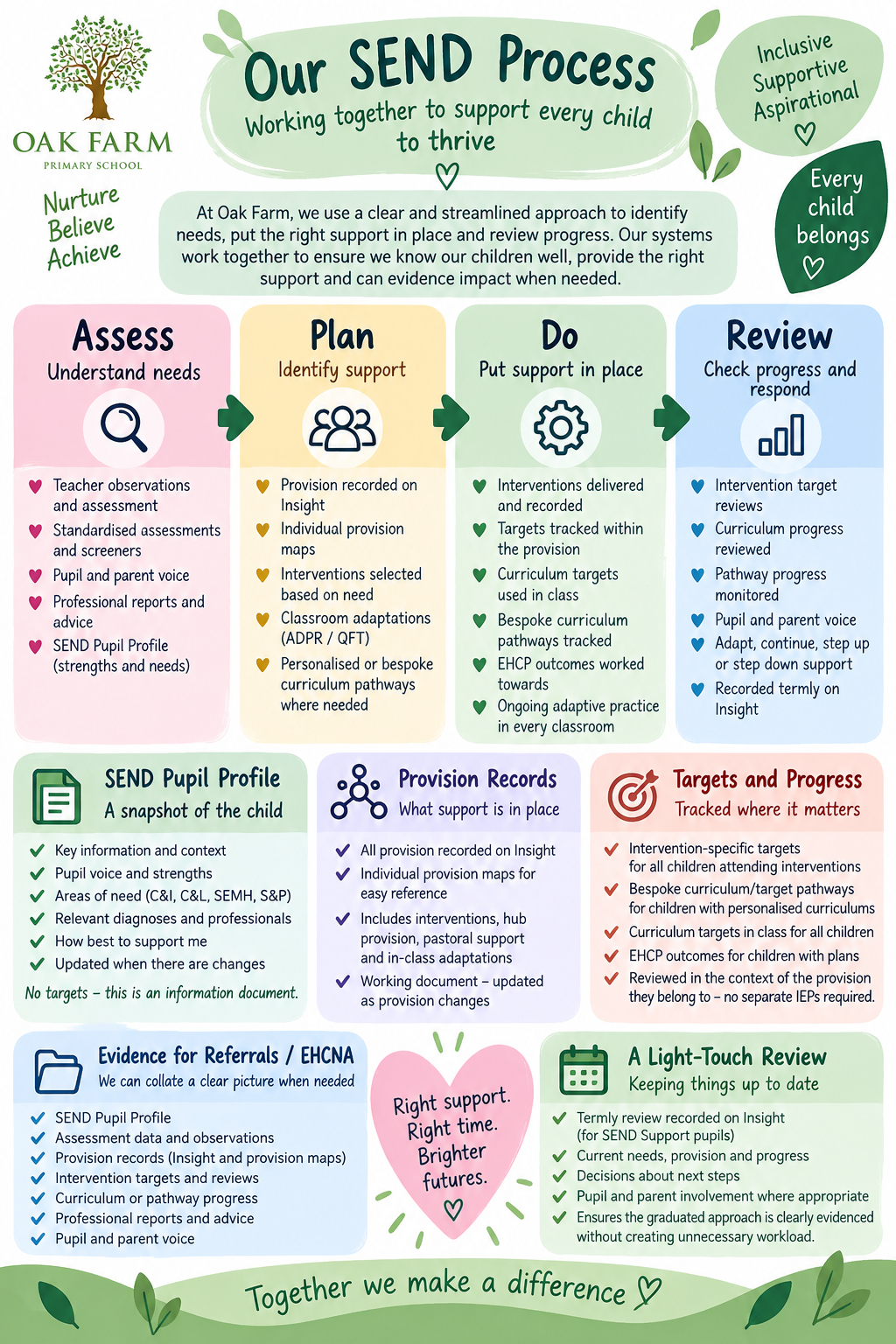
The Graduated Approach at Oak Farm – A Guide for Families
Understanding the Different Levels of Support
Not every child who receives additional help has SEND, and not every child with SEND requires an Education, Health and Care Plan (EHCP).
At Oak Farm, we use a graduated system to ensure that support is proportionate, responsive and matched to individual need.
1. Universal Support – For All Children
Our starting point is high-quality, inclusive teaching and Ordinarily Available Provision (OAP).
This includes adaptive teaching, visual supports, clear routines, explicit vocabulary teaching, additional processing time, modelling, scaffolding and strategies to support communication, attention and emotional regulation.
These approaches are part of everyday classroom practice and benefit all learners, including children with SEND.
2. Targeted Support – For Children Who Need Something Additional
Some children benefit from extra support to address a specific barrier or develop particular skills.
This may include small-group teaching, Language Link, Attention Hillingdon, Building Bricks, nurture groups, additional literacy or numeracy teaching, or emotional regulation support.
Targeted support may be short-term or ongoing. Receiving an intervention does not automatically mean a child is identified as having SEN.
We monitor the impact of interventions and consider whether children are becoming more confident, independent and able to access classroom learning.
3. Specialist or Bespoke Support – For Children with More Complex Needs
Some children require a more individualised approach, specialist professional advice or provision that is significantly additional to or different from that ordinarily available.
This may include specialist speech and language or occupational therapy programmes, individual communication systems, personalised learning pathways, specialist teaching approaches or provision through our Strong Foundations Hubs.
Some children receiving specialist provision have an EHCP, while others may receive bespoke support through SEN Support.
Our aim at every level is to promote inclusion, develop independence and provide the right level of support without unnecessarily limiting children's opportunities.
Monitoring, SEN Support and EHCPs – What's the Difference?
We recognise that these terms can sometimes be confusing for families.
Monitoring – Keeping a Close Eye on Emerging Needs
When a teacher or parent identifies a concern, we begin by gathering information, monitoring progress and considering appropriate classroom adaptations.
We may observe a child over time, use additional assessments, introduce strategies and discuss progress with families.
This is an active process. Monitoring does not mean that we are waiting without providing support.
Some children make good progress following these adjustments and do not require ongoing SEN Support.
SEN Support – Additional or Different Provision
A child is identified as receiving SEN Support when assessment indicates that they have a learning difficulty or disability requiring special educational provision that is additional to or different from that generally made for children of the same age.
At Oak Farm, this decision is informed by the child's individual profile, the nature and persistence of their needs, their response to support and the extent to which barriers affect their learning, development or participation.
Children receiving SEN Support are included on our school's SEN register, and their provision and progress are monitored through the Graduated Approach.
Families are involved in discussions about their child's needs, support and next steps.
Education, Health and Care Plans (EHCPs) – Statutory Support
An EHCP is a legally binding plan issued by the Local Authority for children and young people who require provision through an Education, Health and Care Plan.
It identifies their needs, the outcomes they are working towards and the special educational provision required.
Children with EHCPs continue to access inclusive classroom teaching alongside personalised or specialist provision, as appropriate.
Their plans are formally reviewed at least annually, alongside ongoing monitoring and review of progress.
A diagnosis does not automatically mean a child requires SEN Support or an EHCP, and a child does not need a diagnosis to receive appropriate SEND support.
Our decisions are based on the child's needs and the provision required to help them succeed.
Recording and Reviewing Provision – Using Insight
At Oak Farm, we use Insight, our school assessment and provision tracking system, to ensure that support is carefully planned, recorded and reviewed.
Insight enables us to maintain an overview of each child's needs, record interventions and individual provision, monitor targets, review progress and evaluate the impact of support over time.
We also use Pupil Profiles to help staff understand each child's strengths, needs, preferences and the approaches that work best for them.
This ensures that information is shared appropriately, provision remains consistent and support can be adapted as children develop.
Our focus is always on the difference support makes to the child, rather than simply the amount of intervention or paperwork completed.
Working with External Professionals
We recognise that some children benefit from specialist knowledge and advice beyond the school.
Our SEND team works closely with a range of external professionals and services, including:
-
Speech and Language Therapists (SALT)
-
Occupational Therapists (OT)
-
Educational Psychologists (EP)
-
Hillingdon Local Authority SEND Advisory Service
-
Physiotherapists
-
Visual Impairment and Hearing Impairment Specialist Teams
-
Child and Adolescent Mental Health Services (CAMHS)
-
Child Development Centre (CDC) and other relevant assessment services
Where appropriate, we seek specialist advice, support referrals and work collaboratively to ensure recommendations are reflected in children's everyday school experiences.
Not every child requires an external referral, and professional involvement will depend on individual needs and relevant service criteria.
Our approach remains needs-led, not diagnosis-led. Support in school does not need to wait for a diagnosis or external assessment.
Working in Partnership with Families and Children
We believe that the strongest outcomes are achieved when children, families and school work together.
Parents and carers know their children in ways that assessments alone cannot capture. We value their observations, concerns and aspirations and encourage open communication from the earliest stages.
Equally, children's voices matter. We seek to understand their experiences, preferences, strengths and the things they find difficult, using communication approaches appropriate to their needs.
Partnership may involve informal conversations, parent meetings, SEND reviews, My Support Plans, professional discussions or EHCP Annual Reviews.
We want families to feel informed, involved and confident that their child's needs are understood.
Have a Concern About Your Child?
If you have concerns about your child's learning, communication, development, behaviour or emotional wellbeing, please speak to your child's class teacher in the first instance.
Your child's teacher can discuss what they are noticing in school, listen to your observations and explain what support or monitoring may be appropriate.
Our SENDCo, Mrs Samantha Hunt, is also available to offer guidance and discuss more complex concerns.
Contact our SEND team:
Email: send@oakfarmprimary.org.uk
Telephone: 01895 590375
Oak Farm SEND Policy – Read our full policy
We are proud of our inclusive school community and remain committed to ensuring that every child is understood, supported and given the opportunity to succeed.
Right support. Right time. Brighter futures.
Every Child. Every Opportunity. Every Day.