English as an additional language (EAL)
At Oak Farm Primary School, we are proud of our wonderfully diverse and multilingual community. We recognise that speaking more than one language is a strength, enriching children's identities, relationships and learning experiences.
67% of our pupils speak English as an Additional Language (EAL), with more than 40 languages represented across our school community.
Our aim is to ensure that every child, regardless of their language background or level of English proficiency, feels welcomed, valued and able to participate fully in school life.
We believe that language should never be a barrier to belonging, learning or achievement.

What is EAL?
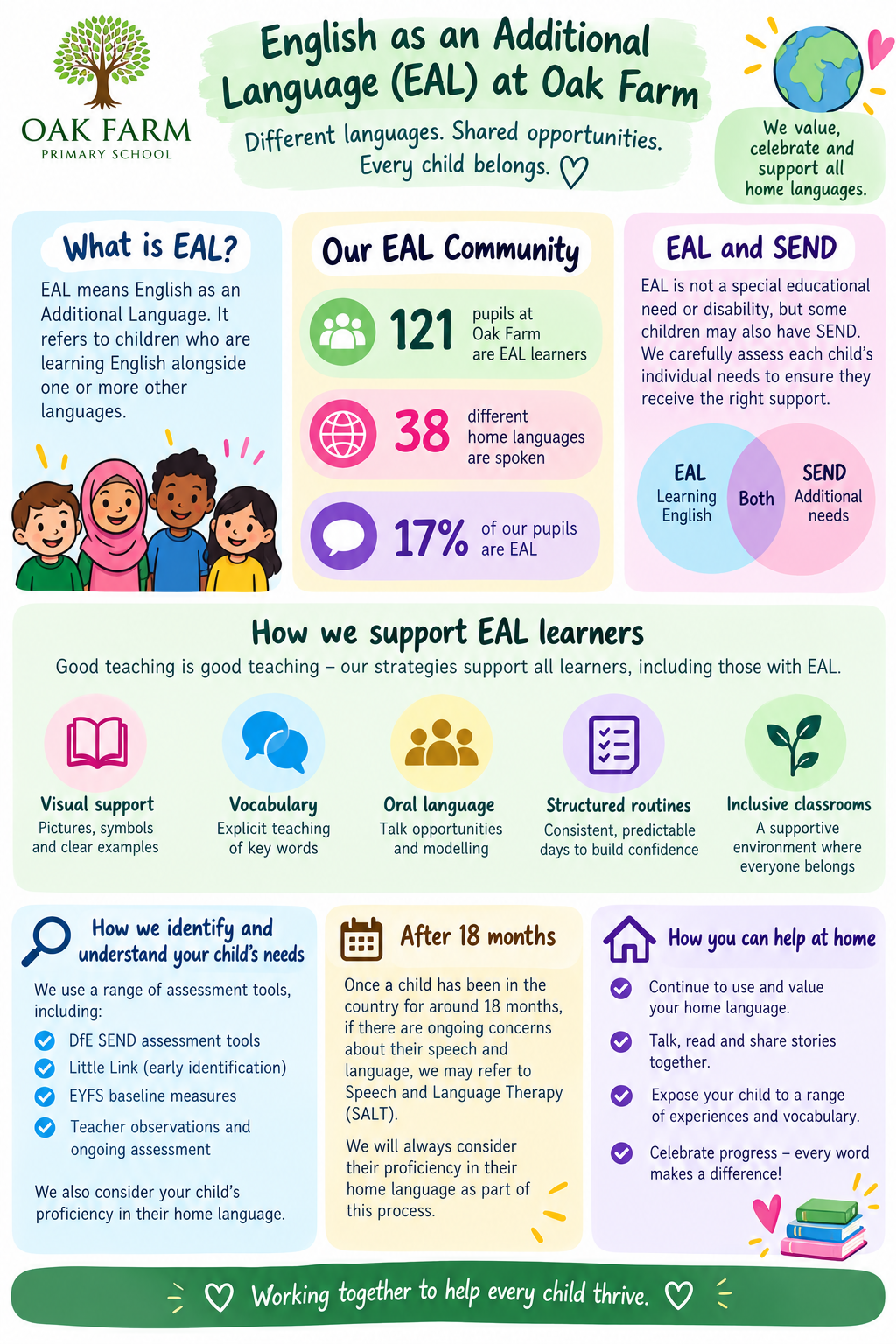
English as an Additional Language (EAL) describes children who are learning English alongside one or more other languages.
Children with EAL have a wide range of experiences. Some are newly arrived in England and are beginning to learn English, while others have lived here all their lives and communicate confidently in several languages.
Importantly, being identified as EAL does not tell us how proficient a child is in English. Two children with EAL may have very different language skills and require very different levels of support.
We recognise and celebrate children's home languages and encourage families to continue speaking, reading and sharing stories in the languages they know best.
Understanding the difference between EAL and SEND
Learning an additional language is not, in itself, a Special Educational Need or Disability (SEND).
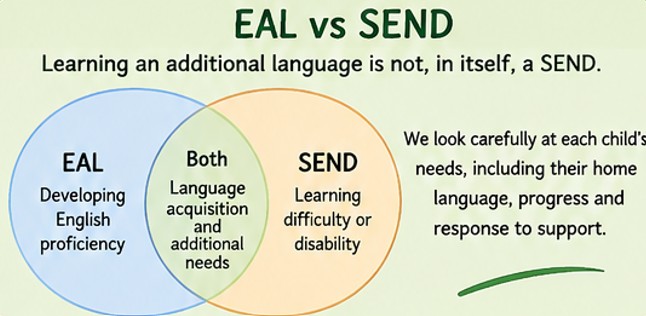
It is important that we distinguish between children who are developing their English proficiency and children who may have an underlying learning, communication or developmental difficulty.
A child who is new to English may initially find it difficult to follow instructions, express ideas, participate in discussions or demonstrate their knowledge. These difficulties do not necessarily indicate SEND.
Equally, children with EAL can also have SEND. We must ensure that genuine additional needs are recognised and supported rather than assuming that all difficulties are related to learning English.
When considering a child's needs, we look carefully at:
-
Their communication and development in their home language.
-
Information shared by parents and carers.
-
Their previous educational experiences and opportunities.
-
Their progress over time with appropriate teaching and language support.
-
Whether difficulties are evident across different languages and learning situations.
A child's proficiency in English is not a measure of their intelligence, ability or potential.
Our approach helps us avoid both incorrectly identifying SEND and overlooking children who may require additional support.
Assessing English language proficiency
At Oak Farm, we believe that effective support begins with understanding each child's individual starting point.
We use The Bell Foundation's EAL Assessment Framework, alongside our own simplified teacher assessment tool, to assess and monitor pupils' developing English proficiency.
The framework considers four areas of language development:
-
Listening: understanding spoken English and classroom instructions.
-
Speaking: communicating ideas and participating in conversations.
-
Reading and Viewing: understanding written language, texts and visual information.
-
Writing: expressing ideas through written English.
Children are assessed using five proficiency bands:
| Band | Level of English proficiency |
|---|
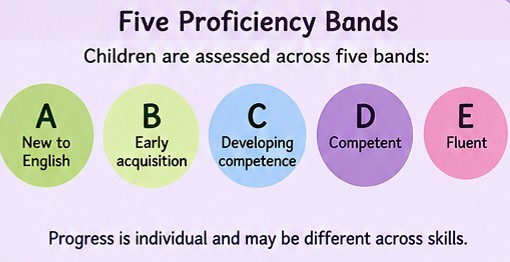
A child may be confident speaking English socially but still require significant support with academic vocabulary, reading comprehension or extended writing.
By assessing different aspects of language separately, teachers can identify strengths, plan appropriate adaptations and monitor progress over time.
Assessment is not about placing limitations on children. It is about understanding how best to support them to succeed.
Explore The Bell Foundation's EAL Assessment Framework
How we support EAL learners
Good teaching is good teaching.
At Oak Farm, the strategies that support children learning English are closely aligned with our Ordinarily Available Provision (OAP) and adaptive teaching approaches.
We do not believe that children with EAL need a separate or simplified curriculum. Instead, we make learning accessible through carefully planned adaptations while maintaining high expectations.
Our everyday classroom strategies include:
-
Visual support: pictures, symbols, objects, demonstrations and visual timetables to support understanding.
-
Explicit vocabulary teaching: introducing, explaining and revisiting important words in meaningful contexts.
-
Modelling: demonstrating tasks and providing examples of spoken and written language.
-
Processing time: allowing children time to listen, think, rehearse and respond.
-
Purposeful talk: providing opportunities to practise language with supportive peers.
-
Scaffolding: using sentence starters, word banks, practical resources and structured activities.
-
Multiple ways to respond: allowing children to demonstrate understanding through pointing, drawing, actions, visuals or practical tasks.
-
Valuing home languages: encouraging children to use their existing language knowledge to support learning.
These strategies benefit all learners and are embedded within our inclusive classroom practice.
Explore Ordinarily Available Provision at Oak Farm
Our Total Communication approach
Our whole-school Total Communication approach also plays an important role in supporting EAL learners.
By combining spoken language with visual supports, gestures, signing and purposeful interactions, we help children understand classroom language and express themselves with growing confidence.
Discover Total Communication at Oak Farm
Welcoming children who are new to English
We understand that joining a new school, particularly in an unfamiliar country or language, can feel overwhelming for children and families.
Our priority is to ensure that children feel safe, welcomed and included from their very first day.
Our new-arrival approach includes opportunities to:
-
Meet with parents and carers to understand the child's language background, experiences and strengths.
-
Introduce the child to key adults, classroom routines and the school environment.
-
Provide visual resources and essential vocabulary to support early communication.
-
Identify a supportive class buddy, including a shared-language peer where appropriate.
-
Assess the child's starting points and English proficiency.
-
Monitor their wellbeing, friendships, participation and progress during their first weeks.
We recognise that some children may initially communicate very little in English while they listen, observe and develop confidence. We provide supportive opportunities to participate without placing unnecessary pressure on them to speak before they are ready.
Our aim is to build a sense of belonging from the outset, while ensuring that children continue to experience an ambitious and engaging curriculum.
When might a child need additional speech and language support?
Learning English takes time, and children develop confidence and proficiency at different rates.
However, we recognise that some children may experience speech, language or communication difficulties that go beyond the expected process of learning an additional language.
When concerns arise, we consider the child's communication skills in all the languages they use, particularly their strongest or home language.
We work closely with parents and carers to understand whether similar difficulties are experienced at home, alongside classroom observations, assessment information and the child's response to support.
As part of our local referral pathway, once a child has been in the country for approximately 18 months, a referral to Speech and Language Therapy (SALT) may be considered where significant concerns persist. This is considered alongside the child's proficiency in their home language, development and wider evidence.
We do not automatically assume that a speech or language difficulty is caused by EAL, and concerns suggesting an underlying disorder may require advice or referral sooner.
Our SENDCo works with families, teachers and relevant professionals to ensure children receive appropriate support.
How families can help at home
Parents and carers play an essential role in supporting children's language development.
We strongly encourage families to continue using their home languages. Children benefit from rich conversations, storytelling, play and shared experiences in the languages their families speak most confidently.
You can support your child by talking about their school day, sharing books and stories, exploring new vocabulary, encouraging conversations and celebrating their progress in every language.
There is no need to stop speaking your home language in order to help your child learn English. A strong foundation in their first language is an important asset.
Working together
At Oak Farm, we see multilingualism as something to celebrate. We are committed to working in partnership with families to ensure every child develops confidence, communication skills and a strong sense of belonging.
If you would like to discuss your child's English language development, please speak to their class teacher in the first instance.
For further advice about language development or possible additional needs, you can contact our SENDCo, Mrs Samantha Hunt.