Total Communication Strategy
At Oak Farm Primary School, we believe that communication is at the heart of everything we do. It underpins learning, relationships, emotional wellbeing, independence and a child's sense of belonging.
Communication is much more than spoken words. Children express themselves through facial expressions, gestures, body language, signs, symbols, pictures, technology, behaviour and speech.
Our Total Communication approach recognises and values these different ways of communicating. By combining methods, we aim to ensure that every child can understand others, express their needs, participate in learning and feel heard.
Total Communication is for everyone, not just children with SEND. It benefits children developing early language, children learning English as an Additional Language (EAL), children with speech and language needs and the wider school community.
A Whole-School Development Priority for 2026–2027
Total Communication is a key priority within our School Development Plan (SDP), sitting at the heart of our commitment to adaptive teaching and inclusive classroom practice.
Throughout this academic year, we are strengthening how communication is supported across every classroom and every part of school life.
Through staff development, classroom practice, monitoring and reflection, we are working to ensure that communication support is consistent, meaningful and embedded within our Ordinarily Available Provision.
Our ambition is simple: every adult understands their role in removing communication barriers and every child has the opportunity to participate.
Pupil Voice – Every Child Has Something to Say
At Oak Farm, we believe that every child has a voice, even when they do not communicate through spoken words.
Listening to children is fundamental to our inclusive approach. We recognise that pupil voice can be expressed through speech, signing, AAC, pictures, gestures, choices, behaviour and other forms of communication.
Our responsibility is to provide accessible ways for children to share their experiences, preferences, feelings and opinions.
This means:
-
Adapting how we gather pupil views to suit individual communication needs.
-
Providing visuals, symbols, AAC and other communication supports where appropriate.
-
Allowing children time to process information and respond.
-
Recognising and respecting non-verbal communication.
-
Involving children meaningfully in decisions about their learning, support and school experiences.
-
Using children's views to inform planning, provision and reviews.
We want every child to feel that their views are not only heard, but genuinely influence what happens next.
Our BSL Ambassadors also play an important role in promoting pupil leadership, celebrating different communication methods and helping build a school culture in which everyone belongs.
What Does Total Communication Look Like at Oak Farm?
Our approach brings together several complementary elements.
1. Building the Foundations of Communication
Communication begins long before children develop spoken language.
Through approaches such as Intensive Interaction, Attention Hillingdon and the Curiosity Approach, we help children develop shared attention, engagement, turn-taking, interaction and enjoyment of communicating with others.
We recognise that meaningful interaction may begin with a look, movement, gesture, expression or shared experience.
2. Developing Spoken Language
Spoken language remains central to our teaching.
Across school, adults model rich language, explicitly teach vocabulary, encourage purposeful conversation and provide opportunities for children to explain, question, discuss and reason.
Where needed, children may receive additional support through Language Link, Building Bricks, Talkabout or programmes informed by Speech and Language Therapists.
Total Communication does not replace speech. It enriches spoken language by providing additional ways to support understanding and expression.
3. Using Visual Support Purposefully
Visuals help children understand routines, instructions, vocabulary, choices and expectations. They can reduce cognitive load, build independence and make learning more accessible.
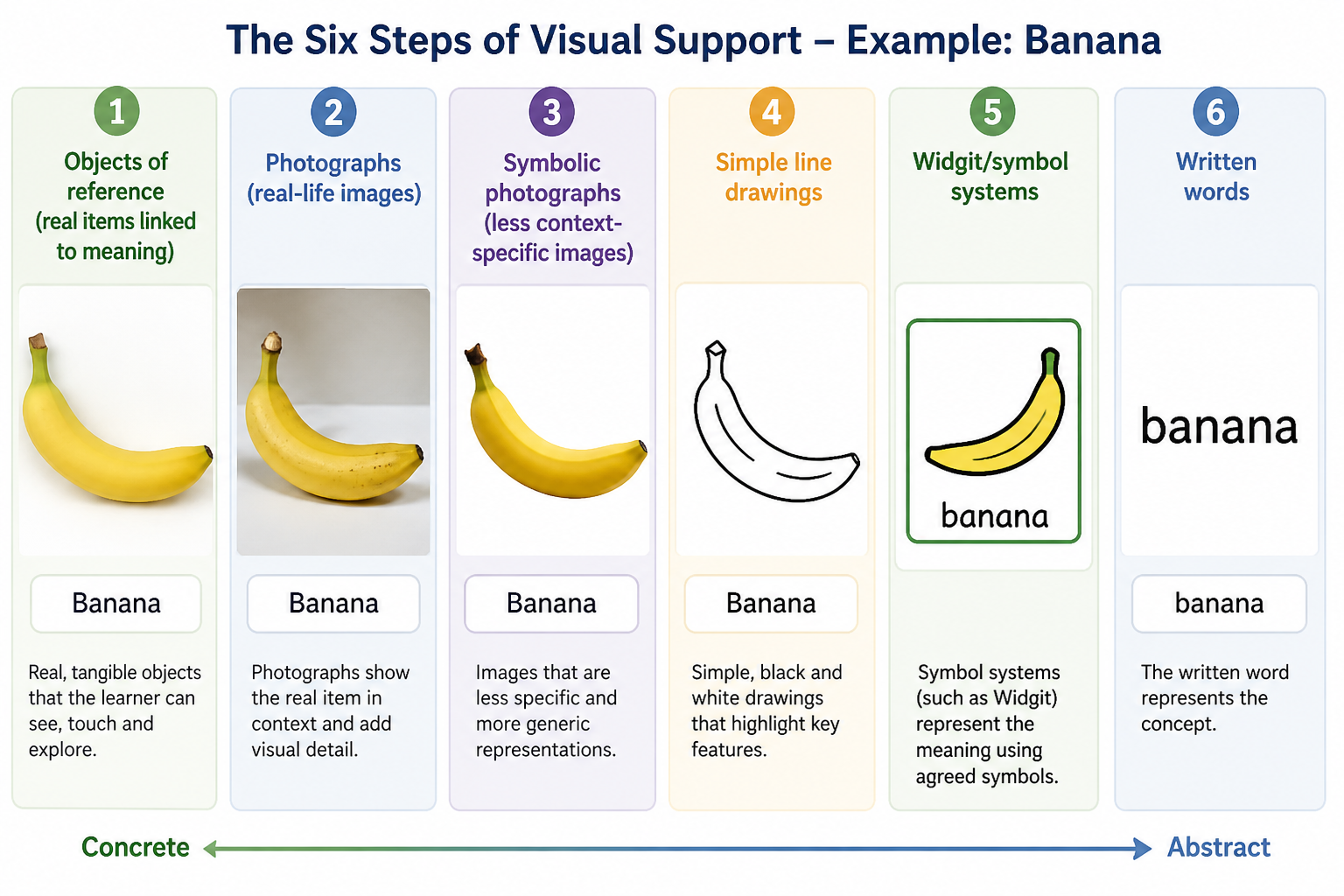
At Oak Farm, we use our Six Steps of Visual Support to help staff select the most appropriate visual representation for each child:
-
Objects of reference
-
Real-life photographs
-
Symbolic photographs
-
Simple line drawings
-
Widgit symbols
-
Written words
These steps move from concrete to increasingly abstract representations. They are not a ladder that every child must complete; we choose visuals according to what is meaningful and accessible to the individual learner.
Visual timetables, now-and-next boards, choice boards, communication boards and classroom symbols are all part of our everyday practice.
4. British Sign Language (BSL)
We are proud to be introducing British Sign Language as a shared part of school life.
BSL is a recognised language with its own grammar and culture. By learning and using signs alongside speech, we aim to strengthen communication, promote inclusion and develop respect for different ways of expressing ourselves.
Throughout the year, children and staff learn and revisit our 50 Core BSL Signs, including everyday greetings, feelings, requests, classroom vocabulary and social language.
Weekly signs are introduced and practised through assemblies, classroom routines and school communications.
50 first BSL signs at Oak Farm
Meet Our BSL Ambassadors
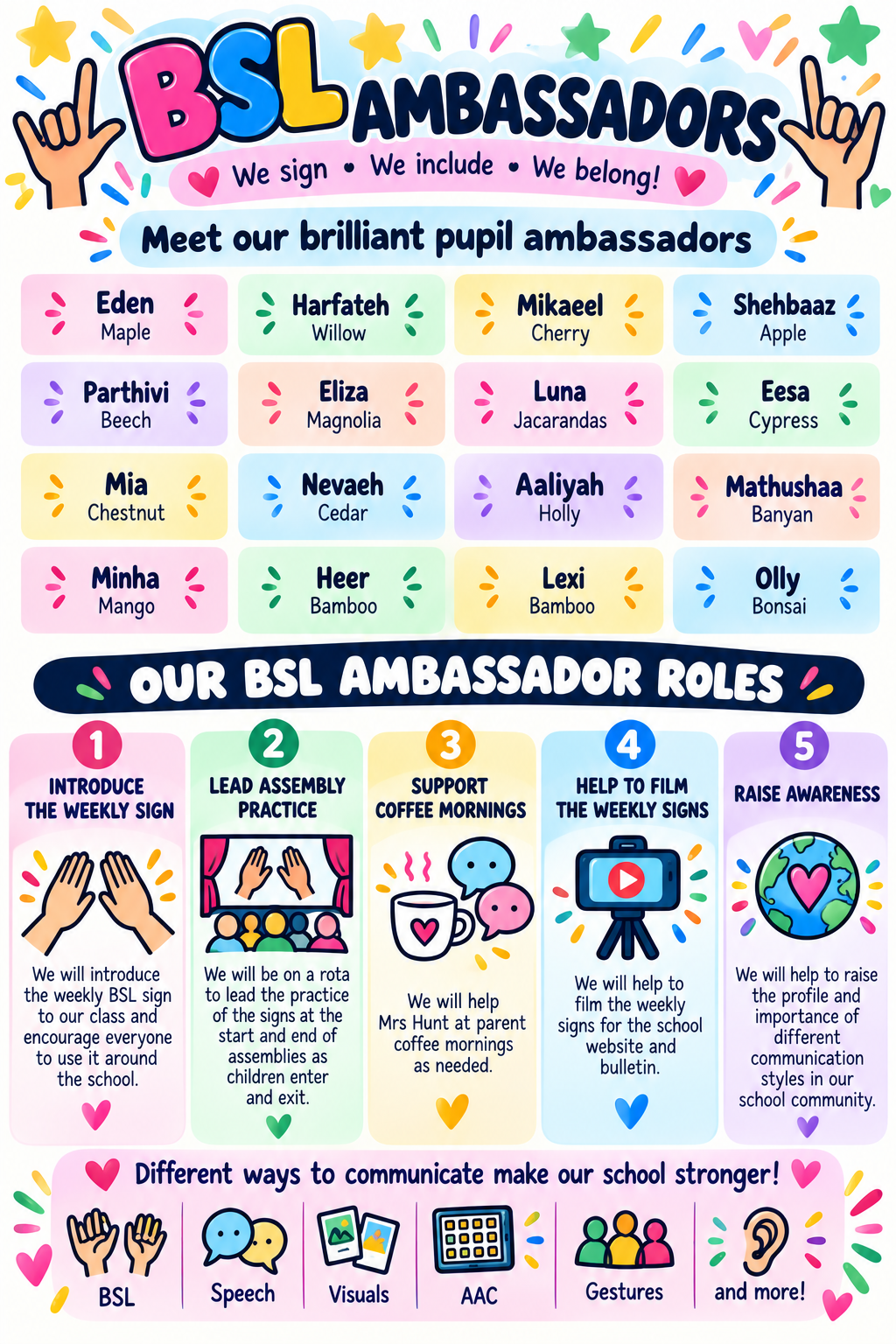
Our pupil BSL Ambassadors help make signing a visible and celebrated part of Oak Farm life.
They introduce the weekly sign to their classes, support signing practice in assemblies, encourage others to participate, help at family coffee mornings and contribute to videos for our school website and bulletin.
Their message is simple:
We sign. We include. We belong!
5. Augmentative and Alternative Communication (AAC)
Some children communicate most effectively when they have additional ways to express themselves.
AAC includes tools and strategies that support or provide alternatives to spoken communication.
At Oak Farm, these may include:
-
Low-tech AAC: Communication boards, picture symbols, choice cards, writing, personalised communication books and word mats.
-
High-tech AAC: Communication apps, voice-output devices and other assistive technology.
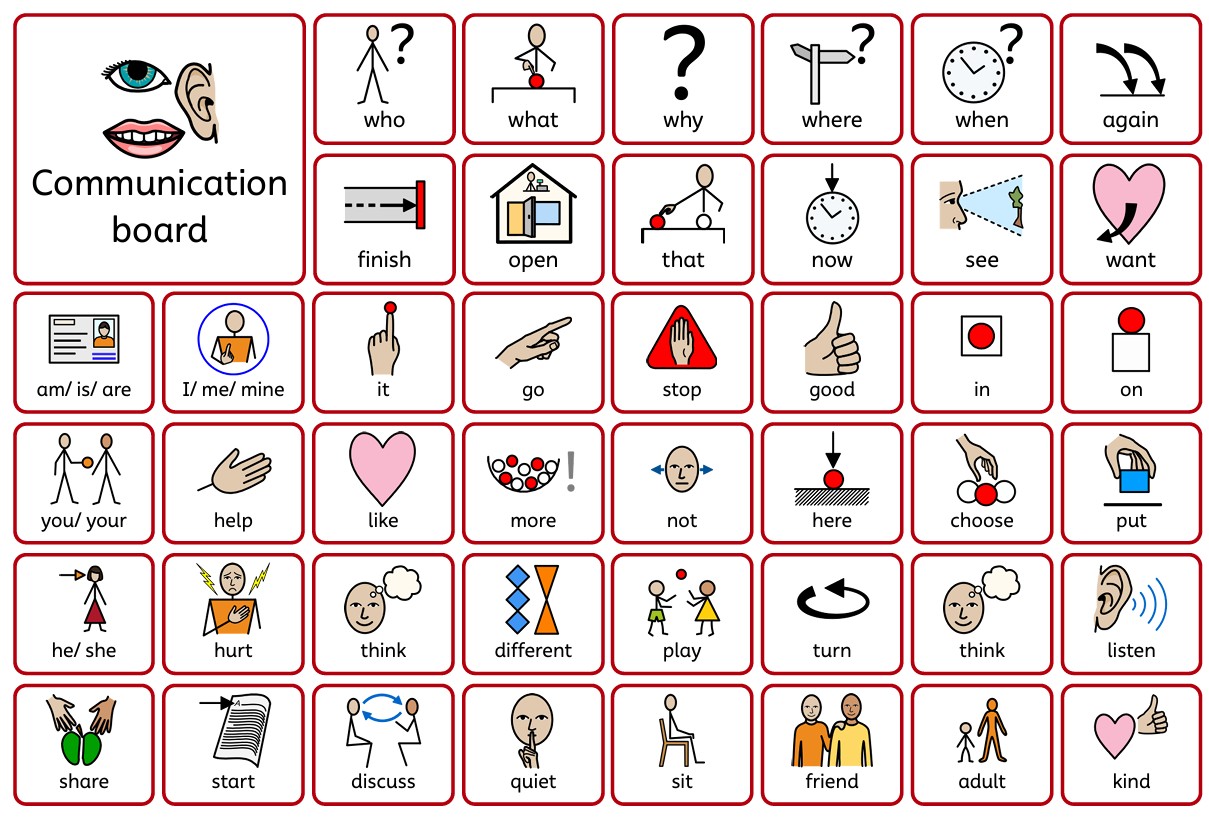
Our communication boards include useful everyday vocabulary such as help, more, stop, want, finished, play and choose. They allow children to communicate a wide range of messages rather than simply respond to questions.
AAC is selected and adapted according to individual needs, with specialist guidance where appropriate.
See an Example of a Communication Board:
Communication Is Everyone's Responsibility
Our Total Communication approach is not limited to specialist interventions or individual classrooms.
Every adult has a role in creating an environment where children feel understood and confident to communicate.
This means speaking clearly, allowing processing time, noticing non-verbal communication, modelling language, using appropriate visuals and responding sensitively to each child's communication attempts.
We also recognise that communication can become more difficult when children feel anxious, overwhelmed or dysregulated. Adults adapt their approach to ensure that children have opportunities to communicate without unnecessary pressure.
Our ambition is for communication support to become a natural, consistent part of everyday school life.
Working Together with Families
Families know their children best, and we value your knowledge of how your child communicates at home.
We want children to experience consistency between school and home wherever possible. Through our newsletters, BSL resources, family workshops and school communications, we aim to share practical ways to support communication together.
You might enjoy practising our weekly BSL sign as a family, using visuals to support everyday routines or giving your child additional time to process and respond.
Read Our Total Communication at Oak Farm Document